Particle Diffusion Matching: Random Walk Correspondence Search for the Alignment of Standard and Ultra-Widefield Fundus Images
Published in IEEE Transactions on Image Processing, 2026
Authors: Kang Geon Lee, Soochahn Lee, Kyoung Mu Lee
TL;DR: Particle Diffusion Matching uses random walk-based correspondence search to align standard fundus images with ultra-widefield fundus images, handling the extreme field-of-view and distortion differences between the two modalities.
What this paper is about
Aligning standard fundus photographs with ultra-widefield (UWF) fundus images is challenging because UWF images cover a much larger retinal area with significant geometric distortion. Traditional registration methods struggle with the scale difference, non-linear distortions, and varying image content between these two capture types.
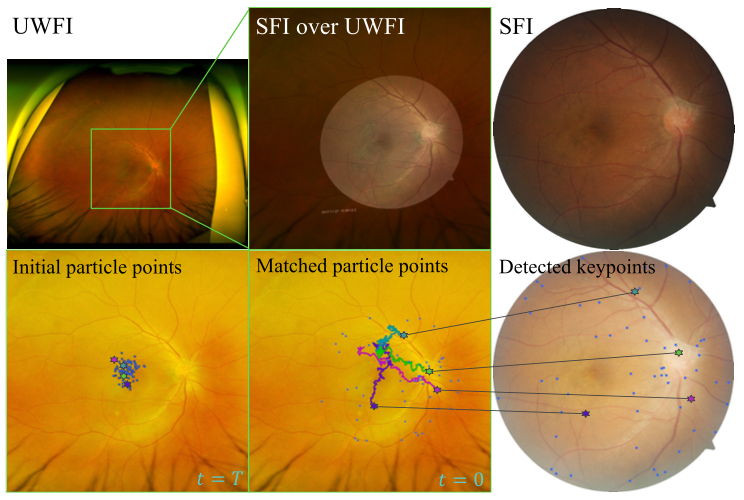 Particle Diffusion Matching (PDM). PDM can align Standard Fundus Images (SFIs) and Ultra-Widefield Fundus Images (UWFIs), which may have extreme differences in view and scale (The resolutions of UWFI and SFI here are approximately 2600 ×2000 and 3600 ×3600, respectively.). In PDM, a particle is defined as a point pair comprising a keypoint from the SFI and a potential matching point from the UWFI. UWFI points are initialized as random Gaussian points at t = T , (bottom left) and undergo random walk correspondence search (RWCS) to eventually reach the matching points (bottom middle) to the paired SFI points (bottom right). The random walk trajectories of four sample particles have been highlighted in various colors.
Key idea
The paper proposes Particle Diffusion Matching, which formulates correspondence search as a random walk process inspired by particle diffusion. This stochastic search strategy explores the correspondence space more effectively than deterministic methods, finding reliable matches even under large geometric and appearance variations.
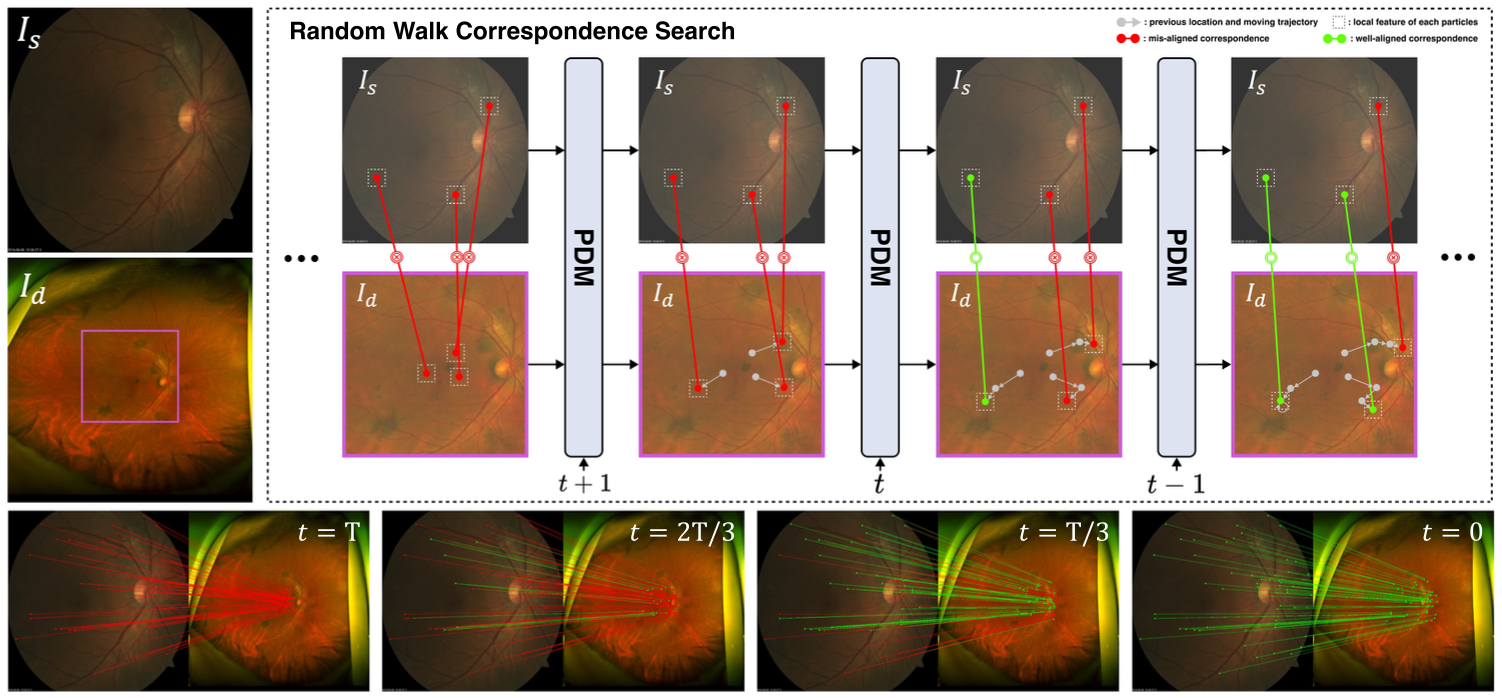 Random Walk Correspondence Search (RWCS). Particles are defined as pairs of points from SFI and UWFI, respectively. Particle random walks at sample steps t + 1, t, and t−1 are depicted. Particle with correct and incorrect correspondences are marked by green and red lines, respectively. The bottom row depicts particles at one-third intervals of the entire sampling process.
Why it matters
PDM is a general-purpose iterative random walk framework that unifies global and local alignment through a stochastic search process, progressively refining transformations to handle both large-scale misalignment and fine-grained local deformations. While demonstrated on the challenging task of aligning standard fundus images with ultra-widefield fundus images, the approach is broadly applicable to general photograph matching problems involving significant geometric and appearance variations.
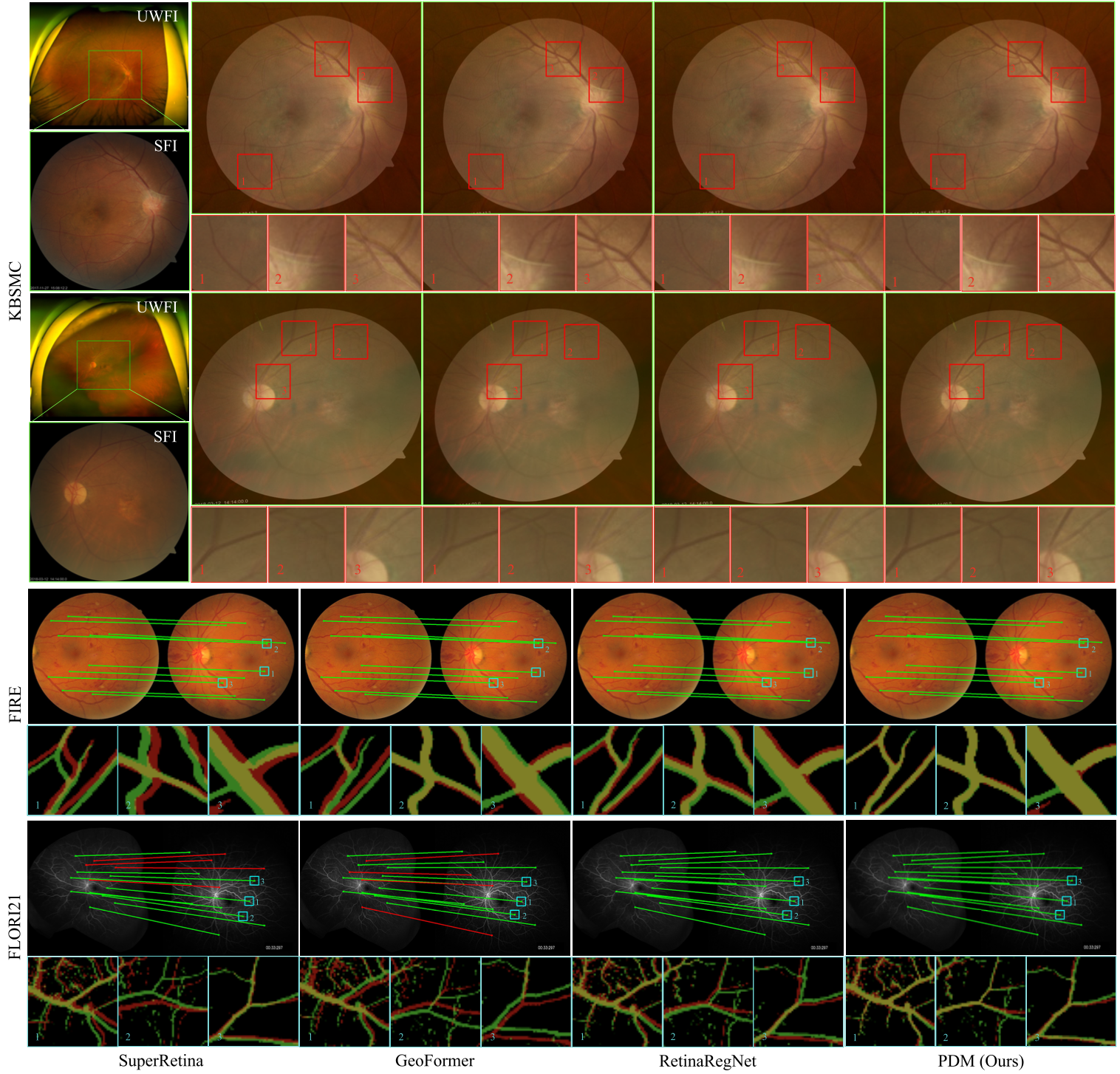 Qualitative evaluation of PDM on the KBSMC, FIRE, and FLORI21 datasets.
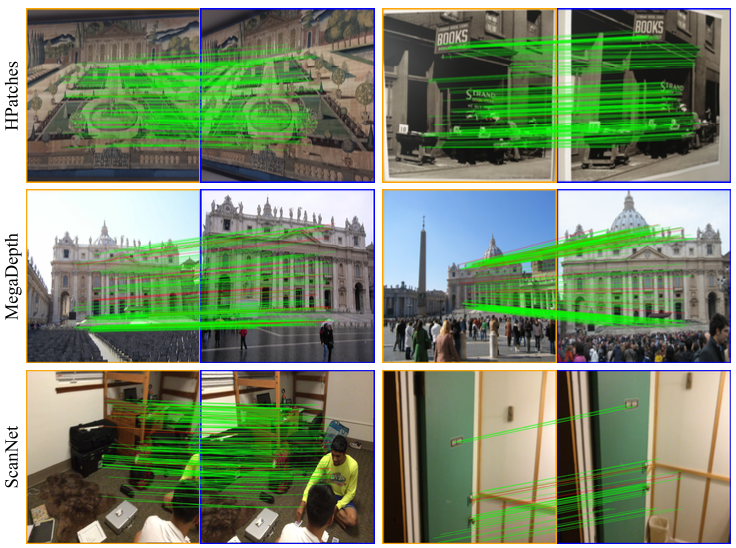 Qualitative evaluation of PDM on the HPatches, MegaDepth, and ScanNet datasets.