Cycle consistent generative motion artifact correction in coronary computed tomography angiography
Published in Applied Sciences, 2024
Authors: Amal Muhammad Saleem, Sunghee Jung, Hyuk-Jae Chang, Soochahn Lee
TL;DR: A cycle-consistent generative approach to remove motion artifacts from coronary CT angiography images, improving diagnostic image quality without requiring paired training data.
What this paper is about
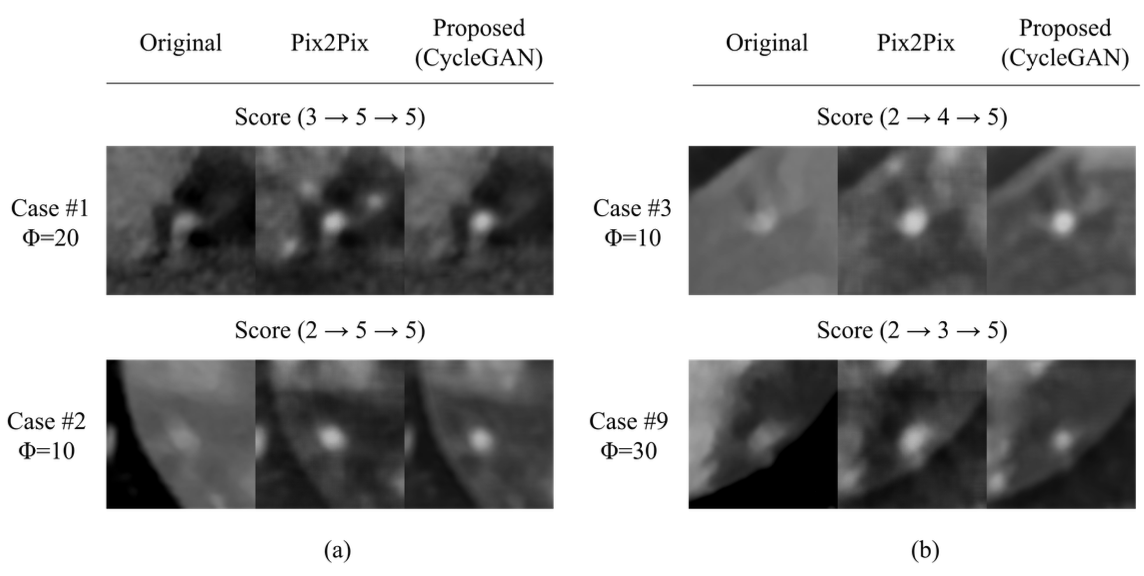 Qualitative examples of the original patch containing the mid-RCA, alongside the results obtained from applying pix2pix and the proposed method, CycleGAN. These samples showcase a range of improvements, with expert evaluations based on a 5-point Likert scale (1 = completely unreadable, 2 = significant motion, 3 = apparent motion, 4 = minor motion, 5 = no motion). Additionally, source information such as case number and phase ϕ in 4D CT is displayed to the left of each sample. (a) represents instances where the scores remained consistent between pix2pix and the proposed method, CycleGAN, while (b) highlights cases where the application of the proposed method, CycleGAN, resulted in improved scores compared to pix2pix.
Motion artifacts in coronary computed tomography angiography (CCTA) are a persistent problem – heart motion during scanning creates blurry or distorted images that can make diagnosis unreliable. Getting artifact-free paired training data is extremely difficult in clinical settings, so supervised approaches are limited.
Key idea
The paper uses a cycle-consistent generative adversarial network to learn the mapping between motion-corrupted and clean CCTA images in an unpaired fashion. By enforcing cycle consistency, the model learns to remove artifacts while preserving the underlying anatomical structures faithfully.
Why it matters
This approach can improve the diagnostic quality of coronary CT scans without requiring repeat imaging or paired datasets, potentially reducing patient radiation exposure and improving clinical workflow.