Revisiting Active Speaker Detection: An In-the-Wild Benchmark for Generalization and Robustness
Published in arXiv preprint arXiv:2505.21954, 2025
Authors: Le Thien Phuc Nguyen, Zhuoran Yu, Khoa Quang Nhat Cao, Yuwei Guo, Tu Ho Manh Pham, Tuan Tai Nguyen, Toan Ngo Duc Vo, Lucas Poon, Soochahn Lee, Yong Jae Lee
TL;DR: UniTalk is a challenging new benchmark for active speaker detection that captures real-world conditions – underrepresented languages, noisy backgrounds, and crowded scenes – and shows that state-of-the-art models which look near-perfect on older benchmarks still fail to generalize.
What this paper is about
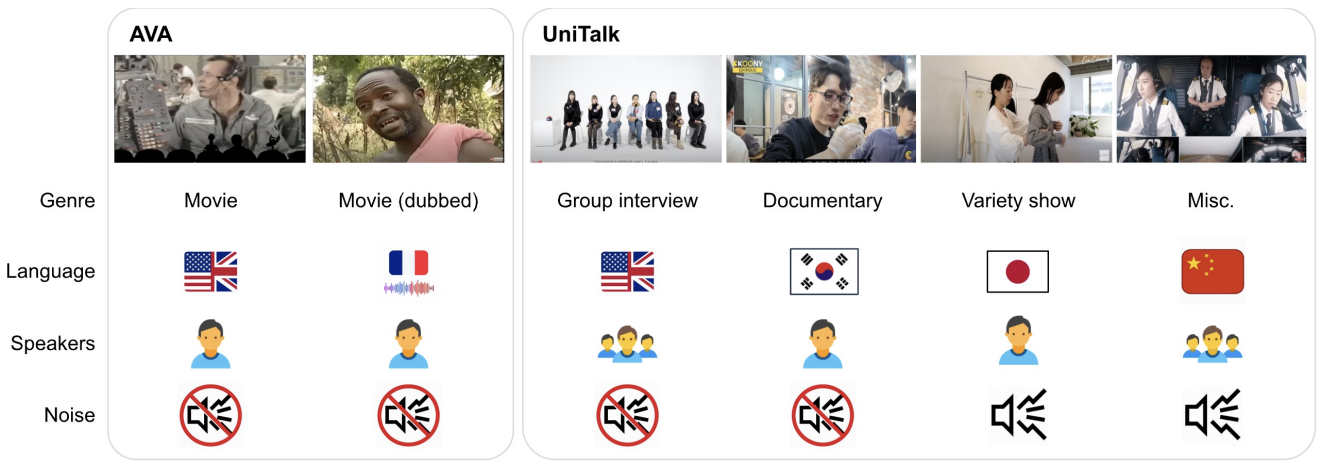
Active speaker detection (ASD) – figuring out who is currently talking in a video – looks almost solved on established benchmarks like AVA. But AVA is built largely from old movies, so it has a large domain gap from real-world video, and strong AVA scores don’t reflect how models behave in the wild.
Key idea
The paper introduces UniTalk, a new ASD benchmark dataset built specifically around challenging in-the-wild conditions – underrepresented languages, noisy backgrounds, and crowded scenes – at a scale comparable to AVA. Evaluating state-of-the-art models reveals that ASD is far from solved: models that are near-perfect on AVA do not saturate on UniTalk, while models trained on UniTalk generalize better to other in-the-wild datasets such as Talkies and ASW.
Why it matters
By exposing the generalization and robustness gaps that older, movie-based benchmarks hide, UniTalk gives the community a realistic testbed for building active speaker detection systems that actually hold up in unconstrained, real-world settings.