Disentangled contrastive learning from synthetic matching pairs for targeted chest X-ray generation
Published in IEEE Access, 2025
Authors: Euyoung Kim, Soochahn Lee, Kyoung Mu Lee
TL;DR: A disentangled contrastive learning framework that uses synthetic matching pairs to enable targeted generation of chest X-ray images with specific pathological characteristics.
What this paper is about
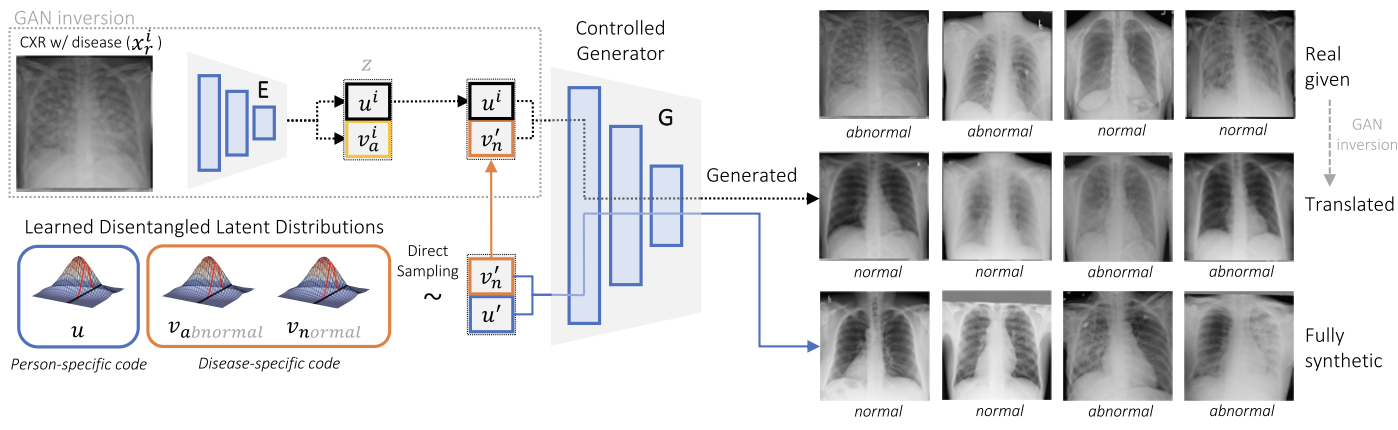 This paper presents a GAN framework that disentangles the latent vector $z$ into two distinct attribute vectors: disease-specific and person-specific attributes denoted by v and u respectively. Disentangled GAN framework offers explicit controls over disease-specific and person-specific attributes in CXR synthesis. (Subscripts a/n of the disease-specific attribute v represent the existence of the disease.) The framework can also synthesize various CXR images of a particular disease, or a healthy image corresponding to the image of a diseased patient, and vice versa, using GAN-inversion.
Generating realistic chest X-rays with specific target conditions (e.g., a particular disease appearance) is valuable for data augmentation and medical training, but it is hard to control what the model generates. Real paired data showing the same patient with and without a condition is scarce.
Key idea
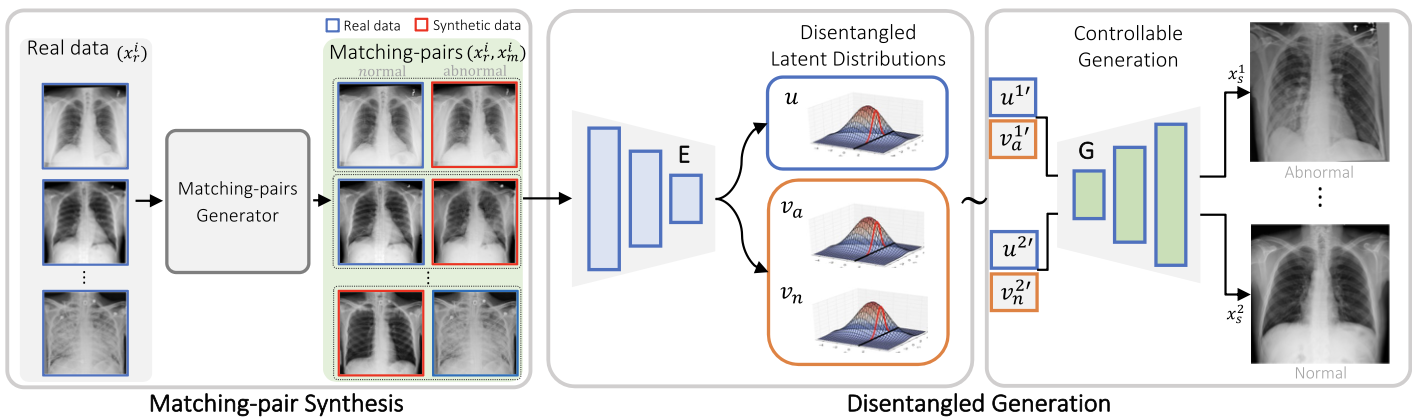 Overview of our framework. Synthetic matching-pair CXRs are constructed and used in contrastive learning to disentangle the latent space into representations of person and disease attributes $u$ and $v$, respectively. Then, these disentangled latent codes enable GAN to synthesize CXR images of desired disease attributes explicitly. For example, an abnormal image is generated by sampling a random person-specific code $u^{1′}$ from $u$ and an abnormal code $v^{1′}_a$ from $v_a$. Similarly, to generate a normal image with a different identity, we resample the person-specific code $u^{2′}$ and a normal code $v^{2′}_n$.
The method creates synthetic matching pairs and uses disentangled contrastive learning to separate disease-related features from patient-specific anatomy. This allows targeted generation where you can specify what pathological changes should appear in the output while keeping the rest of the anatomy consistent.
Why it matters
This enables controlled medical image synthesis that could help with data augmentation for rare conditions and support clinical education, while addressing the fundamental scarcity of paired medical data.
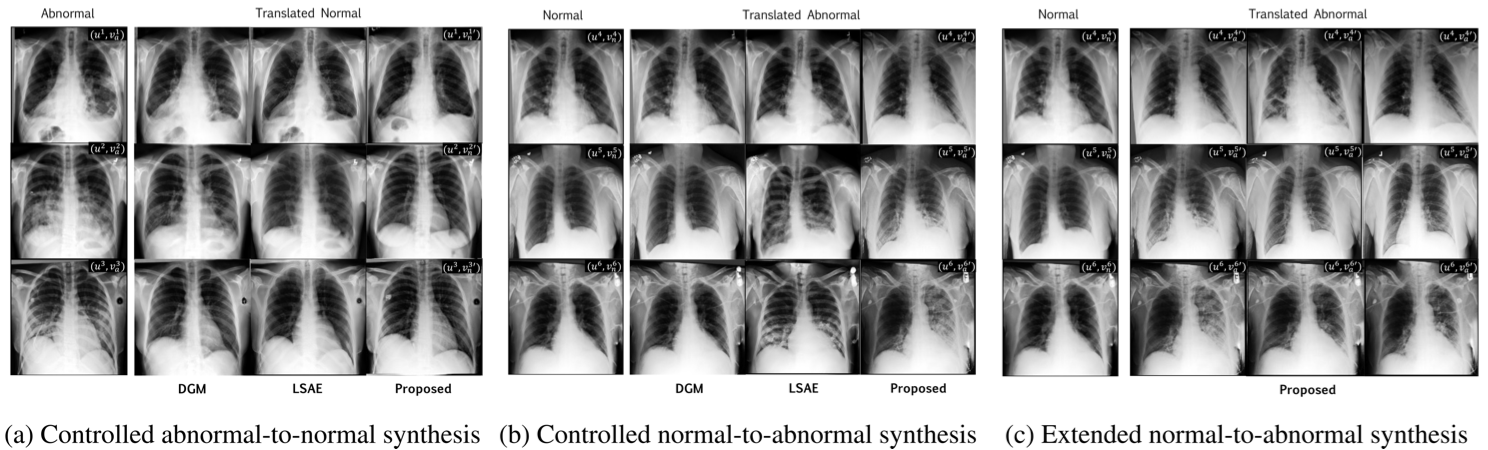 Comparative study on targeted CXR generations. All three methods can synthesize normal CXR images from abnormal CXRs (a). For normal-to-abnormal synthesis, DGM fails, while the proposed model and LSAE effectively synthesizes abnormal CXRs by adding target diseases (b). However, LSAE even alters the contrast of the CXRs depending on target images, whereas the proposed method does not. Moreover, the proposed model can synthesize various abnormal CXRs from the given normal CXR by replacing the different disease-specific attributes while fixing the person-specific attributes (c).