Fingerprint liveness detection by a template-probe convolutional neural network.
Published in IEEE Access, 2019
Authors: Ho Yub Jung, Yong Seok Heo, Soochahn Lee
TL;DR: A CNN-based fingerprint liveness detection method that compares a template fingerprint with a probe fingerprint to determine whether the probe is from a real finger or a spoof.
What this paper is about
 The left fingerprint is a live press fingerprint, whereas the right fingerprint is obtained by pressing a synthetic finger made out of wood-glue. The two fingerprints came from the same finger and so have matching identification. We aim to detect the liveness of the fingerprint press using a convolutional neural network.
Fingerprint-based authentication systems are vulnerable to spoofing attacks using fake fingerprints made from materials like silicone or gelatin. Liveness detection – telling apart real fingers from fakes – is critical for securing these systems. Existing approaches often analyze a single fingerprint image in isolation.
Key idea
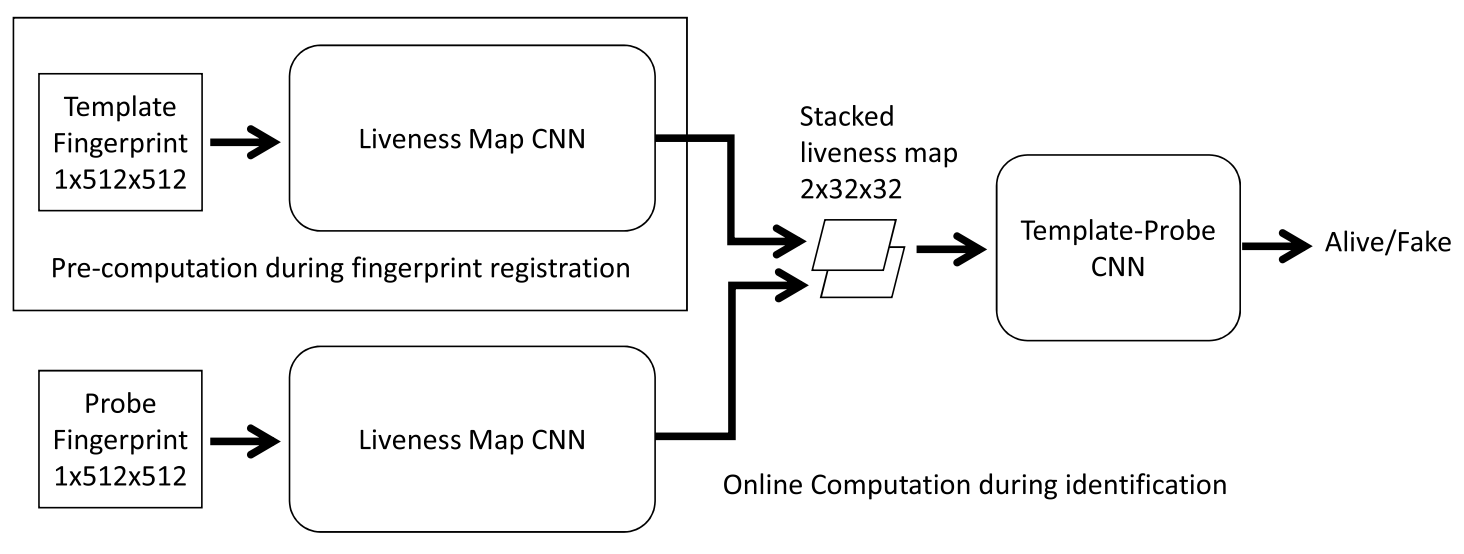 Visual description of the overall process of the proposed approach.
Instead of looking at a single fingerprint, this method uses a template-probe CNN architecture that jointly analyzes both a stored template fingerprint and the newly captured probe fingerprint. By learning the relationship between the two, the network can better detect subtle differences that indicate whether the probe comes from a live finger or an artificial replica.
Why it matters
This pairwise comparison approach provides a more robust liveness detection mechanism, making fingerprint authentication systems harder to fool with spoofed prints.