Forest walk methods for localizing body joints from single depth image.
Published in PLoS ONE, 2015
Authors: Ho Yub Jung, Soochahn Lee, Yong Seok Heo, Il Dong Yun
TL;DR: A “forest walk” method that localizes body joints from a single depth image by traversing decision trees in a spatially guided manner.
What this paper is about
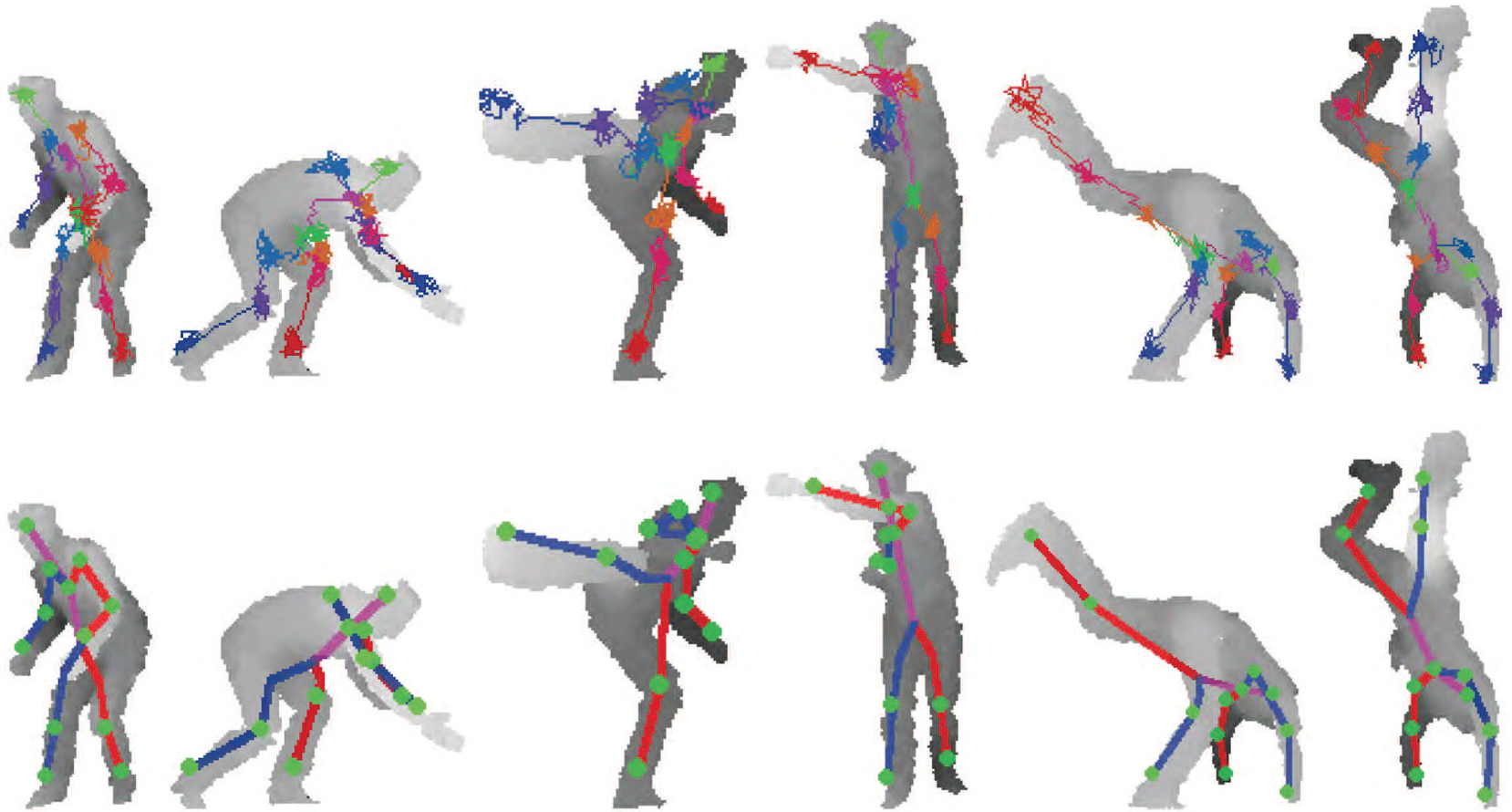 Example results of the RTW from EVAL test data. 64 RTW steps are taken for each joint. The RTW paths are drawn at the top row, the expectations of RTW steps are used to find joint positions in bottom row. The pose estimation from a single image takes less than 1 millisecond.
Estimating human body joint positions from depth images (like those from Kinect sensors) is fundamental for gesture recognition and human-computer interaction. The challenge is doing this accurately and efficiently from just a single depth frame without temporal information.
Key idea
The paper proposes forest walk methods that go beyond standard random forest classification. Instead of independently classifying each pixel, the approach performs guided walks through the forest structure, using spatial relationships between body parts to iteratively refine joint location estimates. This produces more anatomically coherent predictions.
Why it matters
This method improves body joint localization accuracy from single depth images, advancing the state of the art for real-time pose estimation applications in gaming, rehabilitation, and interactive systems.