Classification based micro-calcification detection using discriminative restricted Boltzmann machine in digitized mammograms.
Published in SPIE Medical Imaging, 2014
Authors: Seung Yeon Shin, Soochahn Lee, Il Dong Yun
TL;DR: A classification-based approach using discriminative restricted Boltzmann machines to detect micro-calcifications in digitized mammograms for early breast cancer screening.
What this paper is about
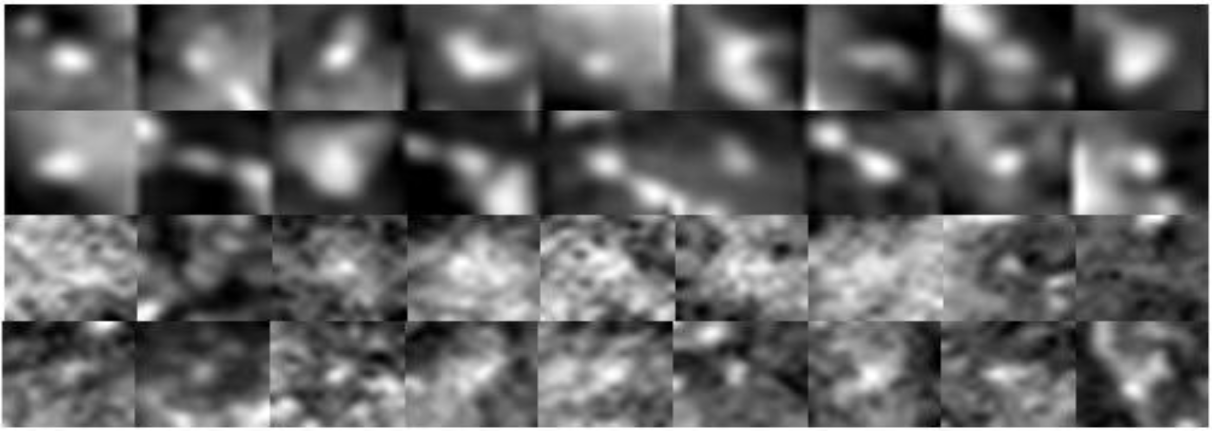 1st, 2nd row: Diversified morphologies of micro-calcifications extracted from a single mammogram. 3rd, 4th: False positives (normal patches classified as MC) and false negatives (MC patches classified as normal) selected from our classification results. These patches are difficult to classify because of their ambiguous morphologies.
Micro-calcifications in mammograms are among the earliest indicators of breast cancer, but they are tiny and easily missed. Automated detection systems need to distinguish these subtle patterns from normal tissue with high sensitivity while keeping false positives low.
Key idea
The paper uses a discriminative restricted Boltzmann machine (RBM) as a classifier for micro-calcification detection. Unlike generative RBMs, the discriminative variant is trained specifically for the classification task, learning features that are directly useful for separating calcification candidates from background tissue.
Why it matters
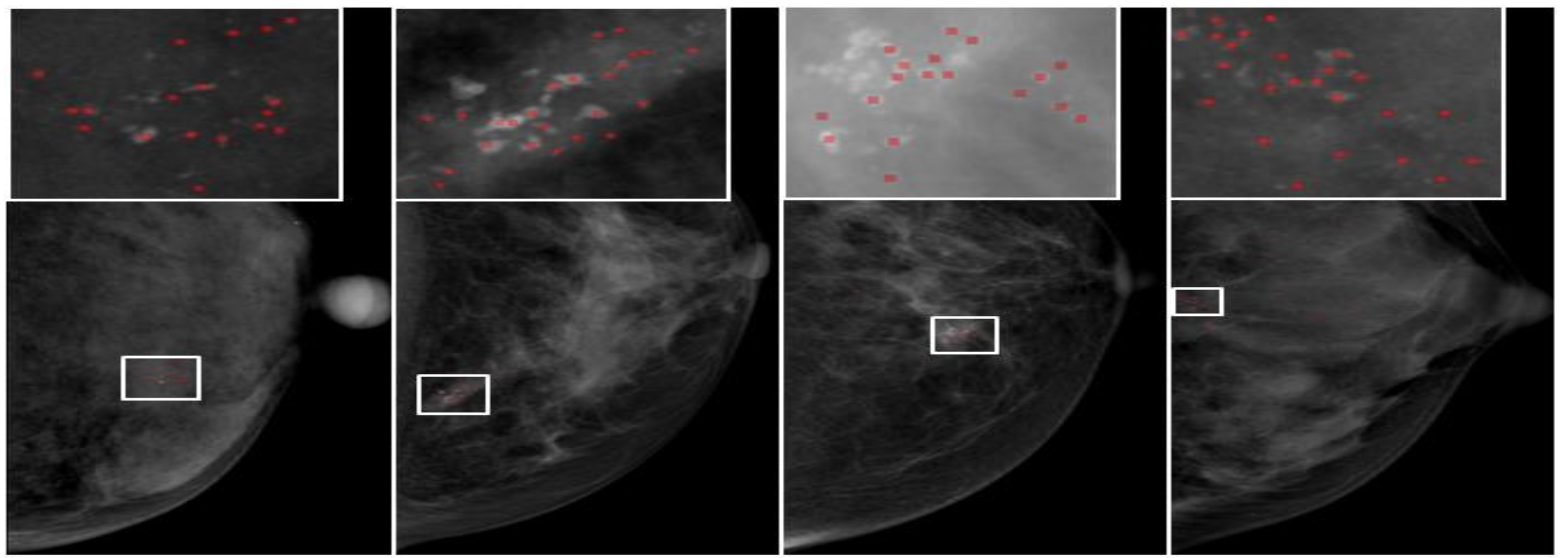 Sample detection results of the proposed method. The pixels with probability of being a MC higher than 50% are represented as red points.
Improving automated micro-calcification detection helps radiologists catch breast cancer earlier, potentially saving lives through more reliable computer-aided diagnosis in mammography screening programs.